


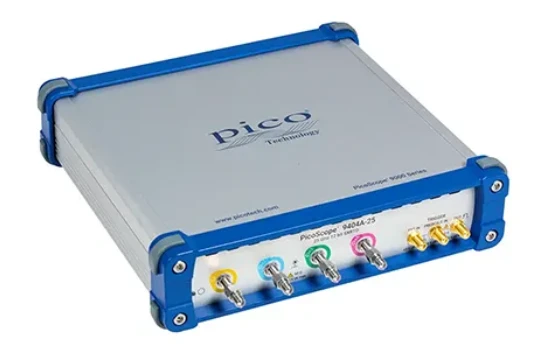
Oscyloskop PicoScope 9404A - 33 CDR
PicoScope 9404-05 5 GHz SXRTO, 4 channels
Kod produktu: PQ408
Opis produktu
SXRTO - Co to jest?
Podstawowy oscyloskop czasu rzeczywistego
Oscyloskopy czasu rzeczywistego (RTO) zostały zaprojektowane z myślą o wystarczająco dużej częstotliwości próbkowania, aby przechwycić w określonej przez urządzenie szerokości pasma analogowego, sygnał przejściowy i niepowtarzalny. Wykryją one impuls o minimalnej szerokości, ale jego zarejestrowany kształt będzie daleki od zadowalającego, nie mówiąc już o jego pomiarach czy charakteryzacji. Typowe oscyloskopy RTO o dużej szerokości pasmai przekraczają częstotliwość próbkowania być może dwukrotnie, osiągając w ten sposób do czterech próbek na cykl lub trzy próbki w impulsie o minimalnej szerokości.
Losowe pobieranie próbek
 W przypadku sygnałów bliskich lub przekraczających granicę Nyquista RTO wiele oscyloskopów RTO może przełączyć się na tryb zwany próbkowaniem losowym. W tym trybie oscyloskop zbiera tyle próbek, ile to możliwe dla każdego z wielu zdarzeń wyzwalających, przy czym każde wyzwolenie dostarcza coraz więcej próbek i szczegółów w zrekonstruowanym przebiegu. Krytyczny dla wyrównania tych próbek jest oddzielny i precyzyjny pomiar czasu między każdym wyzwalaniem i następnym występującym zegarem próbki.
Po dużej liczbie zdarzeń wyzwalających oscyloskop ma wystarczającą liczbę próbek, aby wyświetlić przebieg z żądaną rozdzielczością czasową. Nazywa się to efektywną rozdzielczością próbkowania (odwrotnością efektywnej częstotliwości próbkowania), która jest wielokrotnie wyższa niż jest to możliwe w trybie czasu rzeczywistego.
Technika ta opiera się na losowej zależności między zdarzeniami wyzwalającymi a zegarem próbkowania i może być stosowana tylko w przypadku sygnałów powtarzalnych – tych o stosunkowo stabilnym kształcie fali wokół zdarzenia wyzwalającego.
Oscyloskop SXRTO
 Maksymalna efektywna częstotliwość próbkowania modeli PicoScope 9400 16 GHz wynosi 2,5 TS/s, przy rozdzielczości taktowania 0,4 ps, czyli 5000 razy wyższej niż rzeczywista częstotliwość próbkowania oscyloskopu.
Przy analogowej szerokości pasma do 16 GHz, te SXRTO wymagałyby częstotliwości próbkowania przekraczającej 32 GS/s, aby spełnić kryterium Nyquista i nieco większej (być może 80 GS/s), aby ujawnić kształty fal i impulsów.
Dzięki losowemu próbkowaniu modele 16 GHz dają nam 156 punktów próbkowania w jednym cyklu przy znamionowej szerokości pasma oscyloskopu lub hojne 55 próbek w przedziale od 10% do 90% jego najszybszego czasu przejścia.
Czy zatem SXRTO jest oscyloskopem samplingowym?
Całe to mówienie o częstotliwościach próbkowania i trybach próbkowania może sugerować, że SXRTO jest rodzajem oscyloskopu samplingowego, ale tak nie jest. Nazwa oscyloskop samplingowy umownie odnosi się do innego rodzaju urządzenia. Oscyloskop samplingowy wykorzystuje programowalny generator opóźnienia do pobierania próbek w regularnych odstępach czasu po każdym zdarzeniu wyzwalającym. Technika ta nazywa się sekwencyjnym próbkowaniem w czasie równoważnym i stanowi zasadę działania oscyloskopów PicoScope z serii 9300. Oscyloskopy te mogą osiągać bardzo wysokie efektywne częstotliwości próbkowania, ale mają dwie główne wady: nie mogą przechwytywać danych przed zdarzeniem wyzwalającym i wymagają osobnego sygnału wyzwalającego – albo ze źródła zewnętrznego, albo z wbudowanego modułu odzyskiwania zegara.
Przygotowaliśmy tabelę pokazującą różnice między typami oscyloskopów wymienionymi na tej stronie. Przykładowe produkty to kompaktowe, 4-kanałowe oscyloskopy PicoScope.
| Oscyloskop czasu rzeczywistego | SXRTO | Oscyloskop samplingowy | ||
|---|---|---|---|---|
| Model | PicoSkop 6406E | Seria PicoScope 9404-05 | Seria PicoScope 9404-16 | PicoSkop 9341-30 |
| Pasmo analogowe | 1 GHz* | 5 GHz | 16 GHz | 30 GHz |
| Próbkowanie w czasie rzeczywistym? | 5GS/s | 500 MS/s | 1 MS/s | |
| Próbkowanie sekwencyjne w równoważnym czasie? | NIE | NIE | 15 TS/s | |
| Losowe pobieranie próbek w równoważnym czasie? | NA | 1 TS/s | 2,5 TS/s | 250 MS/s |
| Wyzwalanie na kanale wejściowym? | Tak | Tak | Tak, ale tylko do pasma 100 MHz - wymaga zewnętrznego wyzwalacza lub opcji wewnętrznego przywracania zegara. | |
| Przechwytywanie przed wyzwalaniem? | Tak | Tak | NIE | |
| Rozdzielczość pionowa | 8 bitów | 12 bitów | 16 bitów | |
* Oscyloskopy czasu rzeczywistego o większej przepustowości są dostępne u innych producentów. Na przykład model z analogową szerokością pasma 16 GHz, częstotliwością próbkowania 80 GS/s i 8-bitowym przetwornikiem ADC jest dostępny w cenie zaczynającej się od 470 500 PLN.
Specyfikacja techniczna
| PicoScope model | PicoScope 9404A-25 | ||||
|---|---|---|---|---|---|
| Vertical | |||||
| Number of input channels | 4 (all channels are identical and digitized simultaneously | ||||
| Analog bandwidth (-3 dB)† | *Full bandwidth | DC to 25 GHz | |||
| Middle bandwidth | N/A | ||||
| Narrow bandwidth | DC to 18 GHz | ||||
| Passband flatness | ±1 dB to 4 GHz | ||||
| Calculated rise time (Tr), typical | Calculated from the bandwidth: 10% to 90%: calculated from Tr = 0.35/BW; 20% to 80%: calculated from Tr = 0.25/BW | ||||
| Full bandwidth | 10% to 90%: ≤ 14 ps 20% to 80%: ≤ 10 ps |
||||
| Middle bandwidth | N/A | ||||
| Narrow bandwidth | 10% to 90%: ≤ 19.5 ps 20% to 80%: ≤ 13.9 ps |
||||
| RMS noise | *Full bandwidth | 3.1 mV, maximum, 2.9 mV, typical | |||
| Middle bandwidth | N/A | ||||
| Narrow bandwidth | 2.7 mV, maximum, 2.5 mV, typical | ||||
| Scale factors (sensitivity) | 10 mV/div to 200 mV/div. | ||||
| Adjustable in a 10-12.5-15-20-25-30-40-50-60-80-100-125-150-200-250 mV/div sequence. Also adjustable in 1% fine increments or better. With manual or calculator data entry the increment is 0.1 mV/div. |
|||||
| * DC gain accuracy | ±2% of full scale (±1.5% typical) | ||||
| Position range | ±4 divisions from center screen | ||||
| DC offset range | 10 mV/div to 200 mV/div. | ||||
| Adjustable from –800 mV to +800 mV Manual or calculator data entry: increment is 0.01 mV for offset –99.9 to +99.9 mV, and 0.1 mV for offset –999.9 to +999.9 mV. Referenced to the center of display graticule. |
|||||
| * Offset accuracy | ±2 mV ±2% of offset setting (±1 mV ±1% typical) | ||||
| Operating input voltage | ±800 mV | ||||
| Vertical zoom and position | For all input channels, waveform memories, or functions. Vertical factor: 0.01 to 100 Vertical position: ±800 divisions maximum of zoomed waveform. |
||||
| Channel-to-channel crosstalk (channel isolation) | ≥ 50 dB (316:1) for input frequency DC to 1 GHz ≥ 40 dB (100:1) for input frequency > 1 GHz to 3 GHz |
||||
| ≥ 36 dB (63:1) for input frequency > 16 GHz to ≤ 25 GHz | |||||
| Delay between channels | ≤ 10 ps, typical, between any two channels, full bandwidth, random sampling | ||||
| ADC resolution | 12 bits | ||||
| Hardware vertical resolution | 0.4 mV/LSB without averaging | ||||
| Overvoltage protection | ±1.5 V (DC + AC peak) | ||||
| * Input impedance | (50 ±1.5) Ω. (50 ±1) Ω, typical | ||||
| Input match | Reflections for 20 ps rise time: 10% or less | ||||
| Input coupling | DC | ||||
| Input connectors | 2.92 mm (K)(f) | ||||
| PicoScope model | PicoScope 9404A-25 | ||||
|---|---|---|---|---|---|
| Attenuation | |||||
| Attenuation factors may be entered to scale the oscilloscope for external attenuators connected to the channel inputs. | |||||
| Range | 0.0001:1 to 1 000 000:1 | ||||
| Units | Ratio or dB | ||||
| Scale | Volt, Watt, Ampere, or unknown | ||||
| PicoScope model | PicoScope 9404A-25 | ||||
|---|---|---|---|---|---|
| Horizontal | |||||
| Timebase | Internal timebase common to all input channels. | ||||
| Timebase range (Full horizontal scale is 10 divisions) |
10 ps/div to 1000 s/div | ||||
| Real-time sampling | 10 ps/div to 5 µs/div | ||||
| Roll | 100 ms/div to 1000 s/div | ||||
| Segmented | Total number of segments: 2 to 1024. Rearm time between segments: <1 µs (trigger hold-off setting dependent) | ||||
| Horizontal zoom and position | For all input channels, waveform memories, or functions Horizontal factor: From 1 to 2000 Horizontal position: From 0% to 100% non-zoomed waveform |
||||
| Timebase clock accuracy | Frequency: 500 MHz | ||||
| Initial set tolerance @ 25 °C ±3 °C | ±0.5 ppm | ||||
| Overall frequency stability over operating temperature range | ±2 ppm | ||||
| Aging (over 10 years @ 25 °C) | ±3 ppm | ||||
| Timebase resolution (with random sampling) | 0.2 ps | ||||
| * Delta time measurement accuracy | ± (0.5 ppm * reading + 0.1% * screen width + 2 ps). | ||||
| Pre-trigger delay | Record length / current sampling rate maximum at zero variable delay time | ||||
| Post-trigger delay | 0 to 4.28 s. Coarse increment is one horizontal scale division, fine increment is 0.1 horizontal scale division, manual or calculator increment is 0.01 horizontal scale division. | ||||
| Channel-to-channel deskew range | ±50 ns range. Coarse increment is 100 ps, fine is 10 ps. With manual or calculator data entry the increment is four significant digits or 1 ps | ||||
| PicoScope model | PicoScope 9404A-25 | ||||
|---|---|---|---|---|---|
| Acquisition | |||||
| Sampling models | Real-time | Captures all of the sample points used to reconstruct a waveform during a single trigger event | |||
| Random | Acquires sample points over several trigger events, requiring the input waveform to be repetitive | ||||
| Roll | Acquisition data is displayed in a rolling fashion starting from the right side of the display and continuing to the left side of the display (while the acquisition is running) | ||||
| Maximum sampling rate | Real-time | 500 MS/s per channel simultaneously | |||
| Random | Up to 5 TS/s or 0.2 ps trigger placement resolution. | ||||
| Record length | Real-time sampling: From 50 S/ch to 250 kS/ch for one channel, to 125 kS/ch for two channels, to 50 kS/ch for three and four channels. Random sampling: From 500 S/ch to 250 kS/ch for one channel, to 125 kS/ch for two channels, to 50 kS/ch for 3 & 4 channels |
||||
| Duration at highest real-time sampling rate | 0.5 ms for one channel, 0.25 ms for two channels, 0.125 ms for three and four channels | ||||
| Acquisition modes | Sample (normal) | Acquires first sample in decimation interval and displays results without further processing | |||
| Average | Average value of samples in decimation interval. Number of waveforms for average: 2 to 4096. | ||||
| Envelope | Envelope of acquired waveforms. Minimum, Maximum or both Minimum and Maximum values acquired over one or more acquisitions. Number of acquisitions is from 2 to 4096 in ×2 sequence and continuously. | ||||
| Peak detect | Largest and smallest sample in decimation interval. Minimum pulse width: 1/(sampling rate) or 2 ns @ 50 µs/div or faster for single channel | ||||
| High resolution | Averages all samples taken during an acquisition interval to create a record point. This average results in a higher-resolution, lower-bandwidth waveform. Resolution can be expanded to 12.5 bits or more, up to 16 bits. | ||||
| Segmented | Number of segments: 1 to 1024, rearm time: < 3 μs or user defined hold-off time, whichever is larger (minimum time between trigger events). User can view selected segment, overlaid segments or selected plus overlay. Search segments: step through, gated block and binary search. Segments are delta and absolute time-stamped. | ||||
| PicoScope model | PicoScope 9404A-25 | ||||
|---|---|---|---|---|---|
| Trigger | |||||
| Trigger sources | Internal from any of four channels, External Direct, External Prescaled. | ||||
| Trigger mode | Free run | Triggers automatically but not synchronized to the input in absence of trigger event. | |||
| Normal (triggered) | Requires trigger event for oscilloscope to trigger. | ||||
| Single | Software button that triggers only once on a trigger event. Not suitable for random sampling. | ||||
| Trigger holdoff mode | Time or random | ||||
| Trigger holdoff range | Holdoff by time: Adjustable from 500 ns to 15 s in a 1-2-5-10 sequence or in 4 ns fine increments. Random: This mode varies the trigger holdoff from one acquisition to another by randomizing the time value between triggers. The randomized time values can be between the values specified in the Min Holdoff and Max Holdoff. |
||||
| PicoScope model | PicoScope 9404A-25 | ||||
|---|---|---|---|---|---|
| Internal trigger | |||||
| Trigger style | Edge: Triggers on a rising and falling edge of any source within frequency range DC to 2.5 GHz. Divide: The trigger source is divided down four times (/4) before being applied to the trigger system. Maximum trigger frequency 5 GHz. |
||||
| Clock recovery (optional): 6.5 Mb/s to 11.3 Gb/s | |||||
| Bandwidth and sensitivity | Low sensitivity | 100 mV p-p DC to 100 MHz increasing linearly from 100 mV p-p at 100 MHz to 200 mV p-p at 5 GHz. Pulse Width: 100 ps @ 200 mV p-p typ. | |||
| * High sensitivity | 30 mV p-p DC to 100 MHz increasing linearly from 30 mV p-p at 100 MHz to 70 mV p-p at 5 GHz. Pulse Width: 100 ps @ 70 mV p-p. | ||||
| Level range | –1 V to +1 V in 10 mV increments (coarse). Also adjustable in fine increments of 1 mV. | ||||
| Edge trigger slope | Positive: Triggers on rising edge Negative: Triggers on falling edge Bi-slope: Triggers on both edges of the signal |
||||
| * RMS jitter | Combined trigger and interpolator jitter | ||||
| Edge and divided trigger: 1.5 ps + 0.1 ppm of delay, maximum. 1.2 ps + 0.1 ppm of delay, typical. |
|||||
| Clock recovery trigger (optional): 2 ps + 1.0% of unit interval + 0.1 ppm delay, maximum | |||||
| Coupling | DC | ||||
| PicoScope model | PicoScope 9404A-25 | ||||
|---|---|---|---|---|---|
| External prescaled trigger | |||||
| Coupling | 50 Ω, AC coupled, fixed level zero volts | ||||
| *Bandwidth and sensitivity | 200 mV p-p from 1 GHz to 20 GHz | ||||
| *RMS jitter | 1.5 ps, maximum, 1.2 ps, typical | ||||
| For trigger input slope > 2 V/ns. Combined trigger and interpolator jitter. | |||||
| Prescaler ratio | Divided by 8, fixed | ||||
| Maximum safe input voltage | ±3 V (DC + AC peak) | ||||
| Input connector | SMA(f) | ||||
| PicoScope model | PicoScope 9404A-25 | ||||
|---|---|---|---|---|---|
| External direct trigger | |||||
| Style | Edge | Triggers on a rising and falling edge of any source from DC to 2.5 GHz | |||
| Divide | Trigger source divided by 4 before input to the trigger system. Max. trigger frequency 5 GHz |
||||
| Clock recovery (optional) | 6.5 Mb/s to 11.3 Gb/s | ||||
| Coupling | DC | ||||
| Bandwidth and sensitivity | * Low sensitivity | 100 mV p-p DC to 100 MHz. Increasing linearly from 100 mV p-p at 100 MHz to 200 mV p-p at 5 GHz. Pulse width: 100 ps @ 200 mV p-p typical. |
|||
| High sensitivity | 30 mV p-p DC to 100 MHz. Increasing linearly from 30 mV p-p at 100 MHz to 70 mV p-p at 5 GHz. Pulse width: 100 ps @ 70 mV p-p. |
||||
| Level range | –1 V to 1 V. 10 mV coarse increments. 1 mV fine increments. |
||||
| Slope | Rising, falling, bi-slope | ||||
| * RMS jitter, edge and divided | 1.5 ps + 0.1 ppm of delay, maximum. 1.2 ps + 0.1 ppm of delay, typical. |
||||
| RMS jitter, clock recovery (optional) | 2 ps + 1.0% of unit interval + 0.1 ppm of delay, maximum | ||||
| Maximum safe input voltage | ±3 V (DC+ AC peak) | ||||
| Input connector | SMA(f) | ||||
| PicoScope model | PicoScope 9404A-25 | ||||
|---|---|---|---|---|---|
| Display | |||||
| Persistence | Off: No persistence Variable persistence: Time that each data point is retained on the display. Persistence time can be varied from 100 ms to 20 s. Infinite persistence: In this mode, a waveform sample point is displayed forever. Variable Gray Scaling: Five levels of a single color that is varied in saturation and luminosity. Refresh time can be varied from 1 s to 200 s. Infinite Gray Scaling: In this mode, a waveform sample point is displayed forever in five levels of a single color. Variable Color Grading: With Color Grading selected, historical timing information is represented by a temperature or spectral color scheme providing “z-axis” information about rapidly changing waveforms. Refresh time can be varied from 1 to 200 s. Infinite Color Grading: In this mode, a waveform sample point is displayed forever by a temperature or spectral color scheme. |
||||
| Style | Dots: Displays waveforms without persistence, each new waveform record replaces the previously acquired record for a channel. Vector: This function draws a straight line through the data points on the display. Not suited to multi-value signals such as an eye diagram. |
||||
| Graticule | Full Grid, Axes with tick marks, Frame with tick marks, Off (no graticule). | ||||
| Format | Auto: Automatically places, adds or deletes graticules as you select more or fewer waveforms to display. Single XT: All waveforms are superimposed and are eight divisions high. Dual YT: With two graticules, all waveforms can be four divisions high, displayed separately or superimposed. Quad YT: With four graticules, all waveforms can be two divisions high, displayed separately or superimposed. When you select dual or quad screen display, every waveform channel, memory and function can be placed on a specified graticule. XY: Displays voltages of two waveforms against each other. The amplitude of the first waveform is plotted on the horizontal X axis and the amplitude of the second waveform is is plotted on the vertical Y axis. XY + YT: Displays both XY and YT pictures. The YT format appears on the upper part of the screen, and the XY format on the lower part of the screen. The YT format display area is one screen and any displayed waveforms are superimposed. XY + 2YT: Displays both YT and XY pictures. The YT format appears on the upper part of the screen, and the XY format on the lower part of the screen. The YT format display area is divided into two equal screens. Tandem: Displays graticules to the left and to the right. |
||||
| Colors | You may choose a default color selection, or select your own color set. Different colors are used for displaying selected items: background, channels, functions, waveform memories, FFTs, TDR/TDTs, and histograms. | ||||
| Trace annotation | The instrument gives you the ability to add an identifying label, bearing your own text, to a waveform display. For each waveform, you can create multiple labels and turn them all on or all off. Also, you can position them on the waveform by dragging or by specifying an exact horizontal position. | ||||
| PicoScope model | PicoScope 9404A-25 | ||||
|---|---|---|---|---|---|
| Save/Recall | |||||
| Management | Store and recall setups, waveforms and user mask files to any drive on your PC. Storage capacity is limited only by disk space. | ||||
| File extensions | Waveform files: .wfm for binary format, .txt for verbose format (text), .txty for Y values formats (text) Database files: .wdb Setup files: .set User mask files: .pcm |
||||
| Operating system | Microsoft Windows 7, 8 and 10, 32-bit and 64-bit. | ||||
| Waveform save/recall | Up to four waveforms may be stored into the waveform memories (M1 to M4), and then recalled for display | ||||
| Save to/recall from disk | You can save or recall your acquired waveforms to or from any drive on the PC. To save a waveform, use the standard Windows Save as dialog box. From this dialog box you can create subdirectories and waveform files, or overwrite existing waveform files. You can load, into one of the Waveform Memories, a file with a waveform you have previously saved and then recall it for display. |
||||
| Save/recall setups | The instrument can store complete setups in the memory and then recall them. | ||||
| Screen image | You can copy a screen image into the clipboard with the following formats: Full Screen, Full Window, Client Part, Invert Client Part, Oscilloscope Screen and Oscilloscope Screen. | ||||
| Autoscale | Pressing the Autoscale key automatically adjusts the vertical channels, the horizontal scale factors, and the trigger level for a display appropriate to the signals applied to the inputs. The Autoscale feature requires a repetitive signal with a frequency greater than 100 Hz, duty cycle greater than 0.2%, amplitudes greater than 100 mV p-p. Autoscale is operative only for relatively stable input signals. |
||||
| PicoScope model | PicoScope 9404A-25 | ||||
|---|---|---|---|---|---|
| Marker | |||||
| Marker type | X-Marker: vertical bars (measure time) Y-Marker: horizontal bars (measure volts) XY-Marker: waveform markers |
||||
| Marker measurements | Absolute, Delta, Volt, Time, Frequency and Slope | ||||
| Marker motion | Independent: both markers can be adjusted independently. Paired: both markers can be adjusted together |
||||
| Ratiometric measurements | Provide ratios between measured and reference values. Results in such ratiometric units as %, dB, and degrees. | ||||
| PicoScope model | PicoScope 9404A-25 | ||||
|---|---|---|---|---|---|
| Measure | |||||
| Automated measurements | Up to ten simultaneous measurements are supported. | ||||
| Automatic parametric | 53 automatic measurements available. | ||||
| Amplitude measurements | Maximum, Minimum, Top, Base, Peak-Peak, Amplitude, Middle, Mean, Cycle Mean, DC RMS, Cycle DC RMS, AC RMS, Cycle AC RMS, Positive Overshoot, Negative Overshoot, Area, Cycle Area. | ||||
| Timing measurements | Period, Frequency, Positive Width, Negative Width, Rise Time, Fall Time, Positive Duty Cycle, Negative Duty Cycle, Positive Crossing, Negative Crossing, Burst Width, Cycles, Time at Maximum, Time at Minimum, Positive Jitter p-p, Positive Jitter RMS, Negative Jitter p-p, Negative Jitter RMS. | ||||
| Inter-signal measurements | Delay (8 options), Phase Deg, Phase Rad, Phase %, Gain, Gain dB. | ||||
| FFT measurements | FFT Magnitude, FFT Delta Magnitude, THD, FFT Frequency, FFT Delta Frequency | ||||
| Measurement statistics | Displays current, minimum, maximum, mean and standard deviation on any displayed waveform measurements. | ||||
| Method of top-base definition | Histogram, Min/Max, or User-Defined (in absolute voltage). | ||||
| Thresholds | Upper, middle and lower horizontal bars settable in percentage, voltage or divisions. Standard thresholds are 10–50–90% or 20–50–80%. | ||||
| Margins | Any region of the waveform may be isolated for measurement using left and right margins (vertical bars). | ||||
| Measurement mode | Repetitive or Single-shot | ||||
| Counter | Source | Internal from any of four channels, External Direct, External Prescaled | |||
| Resolution | 7 digits | ||||
| Maximum frequency | Internal or external direct trigger: 5 GHz. External prescaled trigger: 20 GHz | ||||
| Measurement | Frequency, period | ||||
| Time reference | Internal 250 MHz reference clock | ||||
| PicoScope model | PicoScope 9404A-25 | ||||
|---|---|---|---|---|---|
| Mathematics | |||||
| Waveform math | Up to four math waveforms can be defined and displayed using math functions F1 to F4 | ||||
| Categories and math operators | Arithmetic: Add, Subtract, Multiply, Divide, Ceil, Floor, Fix, Round, Absolute, Invert, Common, Rescale Algebra: Exponentiation (e), Exponentiation (10), Exponentiation (a), Logarithm (e), Logarithm (10), Logarithm (a), Differentiate, Integrate, Square, Square Root, Cube, Power (a), Inverse, Square Root of the Sum Trigonometry: Sine, Cosine, Tangent, Cotangent, ArcSine, Arc Cosine, ArcTangent, Arc Cotangent, Hyperbolic Sine, Hyperbolic Cosine, Hyperbolic Tangent, Hyperbolic Cotangent FFT: Complex FFT, FFT Magnitude, FFT Phase, FFT Real part, FFT Imaginary part, Complex Inverse FFT, FFT Group Delay Bit operator: AND, NAND, OR, NOR, XOR, XNOR, NOT Miscellaneous: Autocorrelation, Correlation, Convolution, Track, Trend, Linear Interpolation, Sin(x)/x Interpolation, Smoothing Formula editor: You can build math waveforms using the Formula Editor control window. |
||||
| Operands | Any channel, waveform memory, math function, spectrum, or constant can be selected as a source for one of two operands | ||||
| FFT | FFT frequency span: Frequency Span = Sample Rate / 2 = Record Length / (2 × Timebase Range) FFT frequency resolution: Frequency Resolution = Sample Rate / Record Length FFT windows: The built-in filters (Rectangular, Hamming, Hann, Flattop, Blackman–Harris and Kaiser–Bessel) allow optimization of frequency resolution, transients, and amplitude accuracy. FFT measurements: Marker measurements can be made on frequency, delta frequency, magnitude, and delta magnitude. Marker measurements can be made on frequency, delta frequency, magnitude, and delta magnitude. Automated FFT Measurements include: FFT Magnitude, FFT Delta Magnitude, THD, FFT Frequency, and FFT Delta Frequency |
||||
| PicoScope model | PicoScope 9404A-25 | ||||
|---|---|---|---|---|---|
| Historgram | |||||
| Histogram axis | Vertical or horizontal. Both vertical and horizontal histograms, with periodically updated measurements, allow statistical distributions to be analyzed over any region of the signal. | ||||
| Histogram measurement set | Scale, Offset, Hits in Box, Waveforms, Peak Hits, Pk-Pk, Median, Mean, Standard Deviation, Mean ±1 Std Dev, Mean ±2 Std Dev, Mean ±3 Std Dev, Min, Max-Max, Max | ||||
| Histogram window | The histogram window determines which part of the database is used to plot the histogram. You can set the size of the histogram window to be any size that you want within the horizontal and vertical scaling limits of the scope. | ||||
| PicoScope model | PicoScope 9404A-25 | ||||
|---|---|---|---|---|---|
| Eye diagram | |||||
| Eye diagram | PicoScope can automatically characterize an NRZ and RZ eye pattern. Measurements are based upon statistical analysis of the waveform. | ||||
| NRZ measurement set | X: Area, Bit Rate, Bit Time, Crossing Time, Cycle Area, Duty Cycle Distortion (%, s), Eye Width (%, s), Fall Time, Frequency, Jitter (p-p, RMS), Period, Rise Time Y: AC RMS, Crossing %, Crossing Level, Eye Amplitude, Eye Height, Eye Height dB, Max, Mean, Mid, Min, Negative Overshoot, Noise p-p (One, Zero), Noise RMS (One, Zero), One Level, Peak-Peak, Positive Overshoot, RMS, Signal-to-Noise Ratio, Signal- to-Noise Ratio dB, Zero Level |
||||
| RZ measurement set | X: Area, Bit Rate, Bit Time, Cycle Area, Eye Width (%, s), Fall Time, Jitter P-p (Fall, Rise), Jitter RMS (Fall, Rise), Negative Crossing, Positive Crossing, Positive Duty Cycle, Pulse Symmetry, Pulse Width, Rise Time Y: AC RMS, Contrast Ratio (dB, %, ratio), Eye Amplitude, Eye High, Eye High dB, Eye Opening Factor, Max, Mean, Mid, Min, Noise P-p (One, Zero), Noise RMS (One, Zero), One Level, Peak-Peak, RMS, Signal-to-Noise, Zero Level |
||||
| PicoScope model | PicoScope 9404A-25 | ||||
|---|---|---|---|---|---|
| Mask test | |||||
| Mask test | Acquired signals are tested for fit outside areas defined by up to eight polygons. Any samples that fall within the polygon boundaries result in test failures. Masks can be loaded from disk, or created automatically or manually. | ||||
| Standard masks | SONET/SDH | OC1/STMO (51.84 Mb/s) to FEC 2666 (2.6666 Gb/s) | |||
| OTU2: 10.709 Gb/s) to DT_18FC_TEST (14.025 Gb/s) | |||||
| Fibre Channel | FC133 Electrical (132.8 Mb/s) to FC2125E Abs Gamma Tx.mask (2.125 Gb/s) | ||||
| FC4250 Optical PI Rev13 (4.25 Gb/s) to FC4250E Abs Gamma Tx.mask (4.25 Gb/s) | |||||
| Ethernet | 100BASE-BX10 (125 Mb/s) to 3.125 Gb/s 10GBase-CX4 Absolute TP2 (3.125 Gb/s) | ||||
| InfiniBand | 10Gb Ethernet (9.953 Gb/s) to 10xGb Ethernet (12.5 Gb/s) | ||||
| 2.5 G driver test points (2.5 Gb/s). Ten masks, test points 1 to 10 | |||||
| 5.0G driver test point 1 (5 Gb/s) 5.0G driver test point 6 (5 Gb/s) 5.0G transmitter pins (5 Gb/s) |
|||||
| QDR 10.0 (10 Gb/s) to FDR_Stress_Out (10.0627 Gb/s) | |||||
| XAUI ITU G.703 |
3.125 Gb/s XAUI Far End (3.125 Gb/s) to XAUI-E Near (3.125 Gb/s) DS1, 100 Ω twisted pair (1.544 Mb/s) to 155 Mb 1 Inv, 75 Ω coax (155.520 Mb/s) |
||||
| ANSI T1/102 | S1, 100 Ω twisted pair (1.544 Mb/s) to STS3, 75 Ω coax, (155.520 Mb/s) | ||||
| RapidIO | Serial Level 1, 1.25G Rx (1.25 Gb/s) to Serial Level 1, 3.125G Tx SR (3.125 Gb/s) | ||||
| PCI Express | R1.0a 2.5G Add-in Card Transmitter Non- Transition bit mask (2.5 Gb/s) to R1.1 2.5G Transmitter Transition bit mask (2.5 Gb/s) | ||||
| R2.0 5.0G Add-in Card 35 dB Transmitter Non-Transition bit mask (5 Gb/s) to R2.1 5.0G Transmitter Transition bit mask (5 Gb/s) | |||||
| Serial ATA | Ext Length, 1.5G 250 Cycle, Rx Mask (1.5 Gb/s) to Gen1m, 3.0G 5 Cycle, Tx Mask (3 Gb/s | ||||
| Mask margin | Available for industry-standard mask testing | ||||
| Automask creation | Masks are created automatically for single-valued voltage signals. Automask specifies both delta X and delta Y tolerances. The failure actions are identical to those of limit testing. | ||||
| Data collected during test | Total number of waveforms examined, number of failed samples, number of hits within each polygon boundary | ||||
| PicoScope model | PicoScope 9404A-25 | ||||
|---|---|---|---|---|---|
| Calibrator output | |||||
| Calibrator output mode | DC, 1 kHz or variable frequency (15.266 Hz to 500 kHz) square wave | ||||
| Output DC level | Adjustable from –1 V to +1 V into 50 Ω. Coarse increment: 50 mV, f ine increment: 1 mV. | ||||
| *Output DC level accuracy | ±1 mV ±0.5% of output DC level | ||||
| Output impedance | 50 Ω nominal | ||||
| Rise/fall time | 150 ns, typical | ||||
| *Output connectors | SMA female | ||||
| PicoScope model | PicoScope 9404A-25 | ||||
|---|---|---|---|---|---|
| Trigger output | |||||
| Timing | Positive transition equivalent to acquisition trigger point. Negative transition after user holdoff. | ||||
| Low level | (–0.2 ±0.1) V into 50 Ω | ||||
| Amplitude | (900 ±200) mV into 50 Ω | ||||
| Rise time | 10% to 90%: ≤ 0.45 ns; 20% to 80%: ≤ 0.3 ns | ||||
| RMS jitter | 2 ps or less | ||||
| *Output delay | 4 ±1 ns | ||||
| *Output coupling | DC coupled | ||||
| *Output connectors | SMA female | ||||
| PicoScope model | PicoScope 9404A-25 | ||||
|---|---|---|---|---|---|
| Clock recovery trigger - recovered data output (optional) | |||||
| Data rate | 6.5 Mb/s to 11.3 Gb/s | ||||
| Eye amplitude | 250 mV p-p, typical | ||||
| Eye rise/fall time | 20%–80%: 50 ps, typical | ||||
| RMS jitter | 2 ps +1% of unit interval | ||||
| Output coupling | AC-coupled | ||||
| Output connections | SMA female | ||||
| PicoScope model | PicoScope 9404A-25 | ||||
|---|---|---|---|---|---|
| Clock recovery trigger - recovered clock output (optional) | |||||
| Output frequency (half-full-rate clock output) |
3.25 MHz to 5.65 GHz | ||||
| Output amplitude | 250 mV p-p, typical | ||||
| Output coupling | AC-coupled | ||||
| Output connectors | SMA female | ||||
| PicoScope model | PicoScope 9404A-25 | ||||
|---|---|---|---|---|---|
| General | |||||
| Power supply voltage | +12 V ±5% | ||||
| Power supply current | 2.8 A maximum | ||||
| Protection | Automatic shutdown on excess or reverse voltage | ||||
| AC-DC adaptor | Universal adaptor supplied | ||||
| PC connection | USB 2.0 (high speed). Also compatible with USB 3.0 | ||||
| Ethernet LAN | |||||
| Software | PicoSample 4: Windows 7, 8 and 10 (32-bit and 64-bit versions) | ||||
| PC requirements | Processor, memory and disk space: as required by the operating system | ||||
| Temperature range | Operating: +5 °C to +40 °C for normal operation, +15 °C to +25 °C for quoted accuracy Storage: –20 °C to +50 °C |
||||
| Humidity range | Operating: Up to 85 %RH (non-condensing) at +25 °C Storage: Up to 95 %RH (non-condensing) |
||||
| Environment | Up to 2000 m altitude and EN61010 pollution degree 2 | ||||
| Dimensions (W × H × D) | 244 x 54 x 233 mm | ||||
| Net weight | 1.52 kg | ||||
| Compliance | CFR-47 FCC (EMC), EN61326-1 (EMC) and EN61010-1 (LVD) | ||||
| Warranty | 5 years | ||||


 Zaloguj przez Facebooka
 Zaloguj przez Google
